Discussions
"In my opinion, an educator must be a knowledge transmitter [...]"
In response to topic:
The educator’s role: knowledge transmitter or partner in growth?
Updates
Study HUB visit: true inspiration
From Inspiration to Practice: Portuguese and Hungarian Partners Explore Dutch Entrepreneurship [...]
Date: October 3, 2026
Study HUB visit: true inspiration
Date: October 3, 2026
From Inspiration to Practice: Portuguese and Hungarian Partners Explore Dutch Entrepreneurship HUBs
What does an effective Entrepreneurship HUB look like in practice? And how can vocational education create an environment where students do not just learn about entrepreneurship, but actually experience, test and develop it?
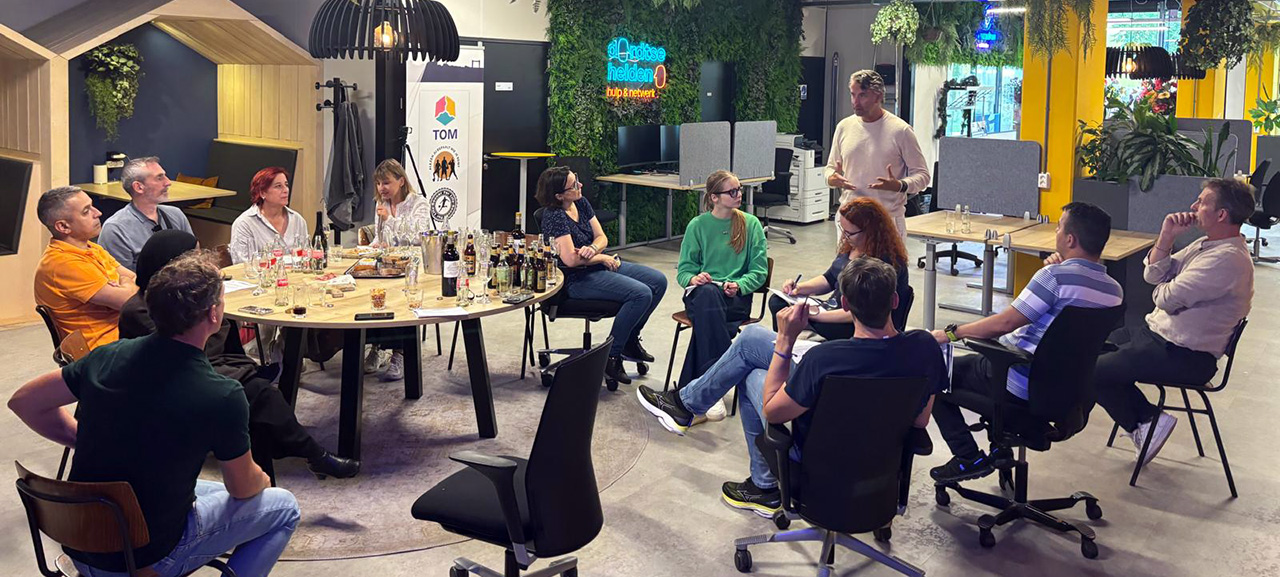
These questions were at the heart of the C-ENTRE HUB Study Visit, held in the Netherlands from 30 September to 2 October 2026. During three inspiring days, education professionals from Portugal and Hungary joined Dutch colleagues to explore how Entrepreneurship HUBs can connect students, education, businesses and the wider entrepreneurial ecosystem.
Three days, three locations, one shared question
The programme brought participants to Utrecht, Dordrecht and Leeuwarden, offering a diverse look at entrepreneurship within Dutch VET education.
Rather than focusing on theory alone, the study visit was designed around real-world examples, practical exchange and reflection. Participants could see different HUB models in action, talk to the people involved and discuss what makes these initiatives successful.
The Portuguese and Hungarian participants also brought their own experiences and perspectives. This made the visit a genuine international exchange: the aim was not to copy a Dutch model, but to identify ideas that could be adapted to different educational and regional contexts.
Day 1: Entrepreneurship in practice in Utrecht and Dordrecht
The first day started at Grafisch Lyceum Utrecht, where participants explored how entrepreneurship and entrepreneurial support can be integrated into a VET programme.
The visit included a presentation on entrepreneurship and support within the curriculum, a tour of the facilities and Entrepreneurship HUB spaces, and discussions with teachers, students and project leaders. Together, participants explored the success factors and lessons learned from the Utrecht approach.
In the afternoon, the group travelled to the Drechtsteden Entrepreneur Centre at DaVinci College in Dordrecht.
Here, participants encountered a larger entrepreneurial ecosystem, with around 80 regular tenants, including startups, VET entrepreneurs and corporates. The visit focused on a question that is highly relevant for anyone developing an Entrepreneurship HUB:
How do you start small and grow big?
The combination of a physical environment, entrepreneurial activity and connections between students and businesses provided plenty of inspiration for the international visitors.
Day 2: Innovation, creativity and cross-level collaboration in Leeuwarden
The second day took the group to Leeuwarden and the Media Innovation Campus (MICA).
MICA demonstrated how innovation, creativity and entrepreneurship can come together in one environment. Participants received an introduction from CEO Didier Kick, explored practical examples during a tour and discussed how education, businesses and students can collaborate effectively.
A special part of the programme was a live English-language podcast recording about the value and potential of Entrepreneurship HUBs within vocational education. Representatives from the participating countries had the opportunity to contribute to the conversation and share their perspectives.
The afternoon continued at the Centre for Entrepreneurship, where the focus shifted to supporting student entrepreneurs and creating opportunities for collaboration between VET and university students.
During a co-creation session, participants explored how students from different educational levels can work together on entrepreneurial projects. This highlighted an important principle: entrepreneurship thrives when educational boundaries become opportunities for collaboration rather than barriers.
Learning goes both ways
Although the study visit focused on Dutch examples, it was never a one-way learning experience.
The Portuguese and Hungarian partners brought valuable experiences from their own countries, creating opportunities to compare national approaches, discuss challenges and identify common opportunities.
This international perspective is at the heart of C-ENTRE. The project brings together partners working on coaching in VET entrepreneurship education, with a shared ambition to strengthen the way students are supported in developing entrepreneurial competences.
The visit demonstrated that there is no single formula for a successful Entrepreneurship HUB. The environments in Utrecht, Dordrecht and Leeuwarden are different, but they share several important characteristics: space for experimentation, access to entrepreneurs and professionals, coaching and guidance, and strong connections between education and the world of work.
Day 3: Looking back — and looking forward
The final day was dedicated to reflection and future collaboration.
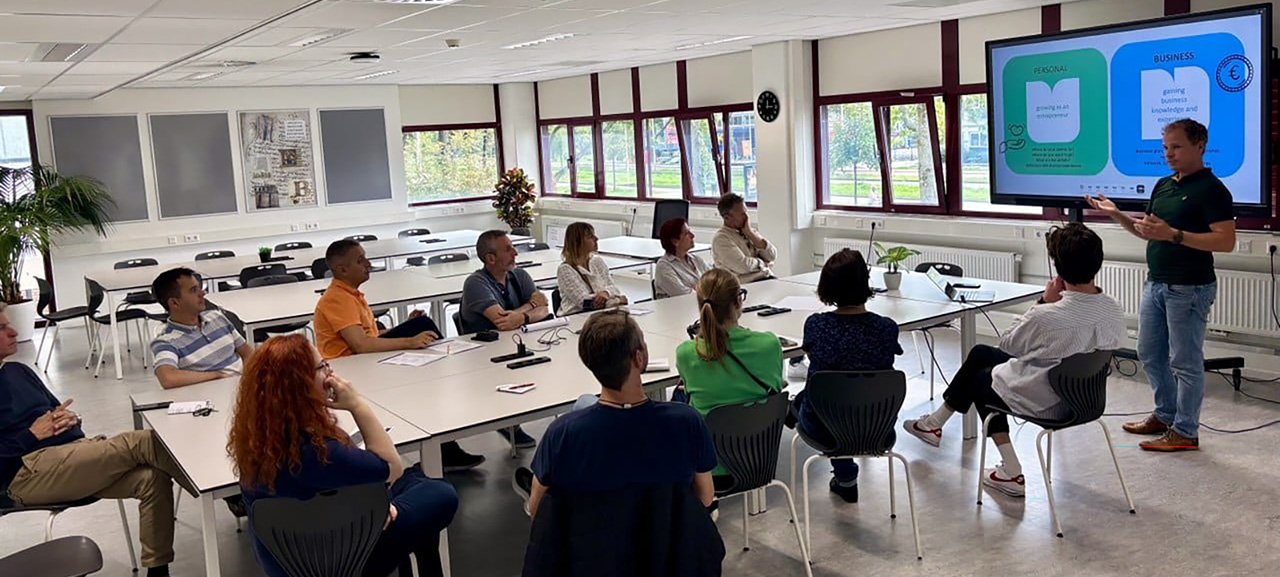
During an interactive session, participants considered what they could take back to their own institutions at MICRO, MESO and MACRO level. They compared European and national experiences, explored new opportunities for cooperation and reflected on how the insights from the study visit could be translated into their own educational contexts.
This final step was essential. A study visit is only truly valuable when inspiration leads to action.
The challenge for every participant is therefore not to reproduce a Dutch HUB, but to ask:
What can we adapt, develop and improve in our own institution?
There is no one-size-fits-all HUB
One of the key lessons from the three days is that an Entrepreneurship HUB does not have to look the same everywhere.
A HUB can be closely connected to a VET programme, embedded in a broader entrepreneurial ecosystem, focused on creative industries, or designed around collaboration between different educational levels.
What matters is the underlying approach: creating an environment where students can experiment, receive guidance, connect with the real world and learn by doing.
The study visit showed that the strength of an Entrepreneurship HUB is not simply its physical space. It is the people, relationships, coaching and opportunities that bring that space to life.
From international exchange to local impact
For the Portuguese and Hungarian participants, the three-day visit offered new perspectives on how entrepreneurship can be embedded in VET education. For the Dutch hosts, it was equally valuable to hear how colleagues from other European countries approach similar challenges.
That is the real value of international cooperation: we return home not only with new ideas, but with new questions, new connections and new possibilities for collaboration.
The C-ENTRE HUB Study Visit brought these perspectives together — from Utrecht and Dordrecht to Leeuwarden, and from the Netherlands to Portugal and Hungary.
Because entrepreneurship education is ultimately not about building the perfect HUB.
It is about creating the conditions in which students can try, learn, reflect, collaborate and turn ideas into action.
And that is where entrepreneurial learning really begins.
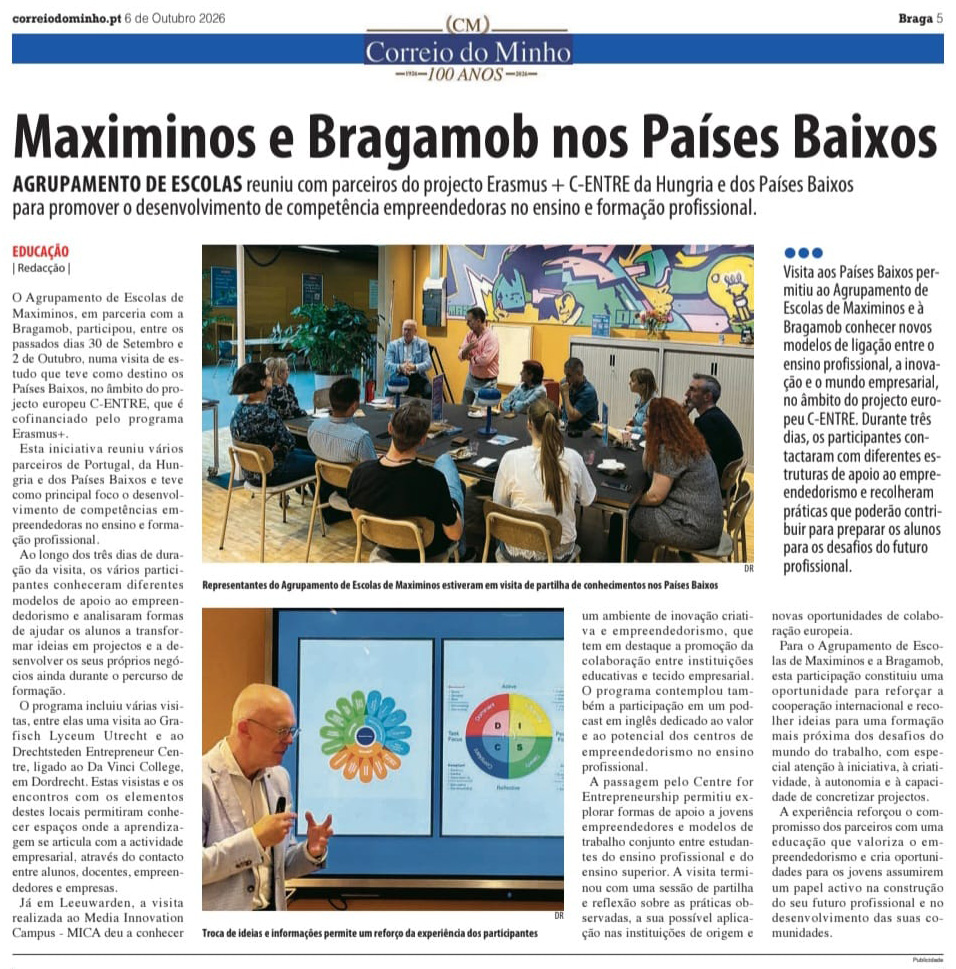
Article in Portuguese newspaper:
 Join our HUB study visit
Tips & tricks
What if students are afraid to take risks or fail?
Quotes
Practical tools on entrepreneurship education
Dutch participant Anja Zijlstra especially highlighted the practical tools on entrepreneurship education: [...]
C-ENTRE: your inspiration on coaching in VET Entrepreneurship Education